Understanding Nylon Mesh Filter Opening Size in Practical Filtration Applications
By focusing on opening size as a functional parameter rather than just a specification number, users can make more informed decisions and achieve better performance from nylon filter mesh in a wide range of industrial and commercial applications.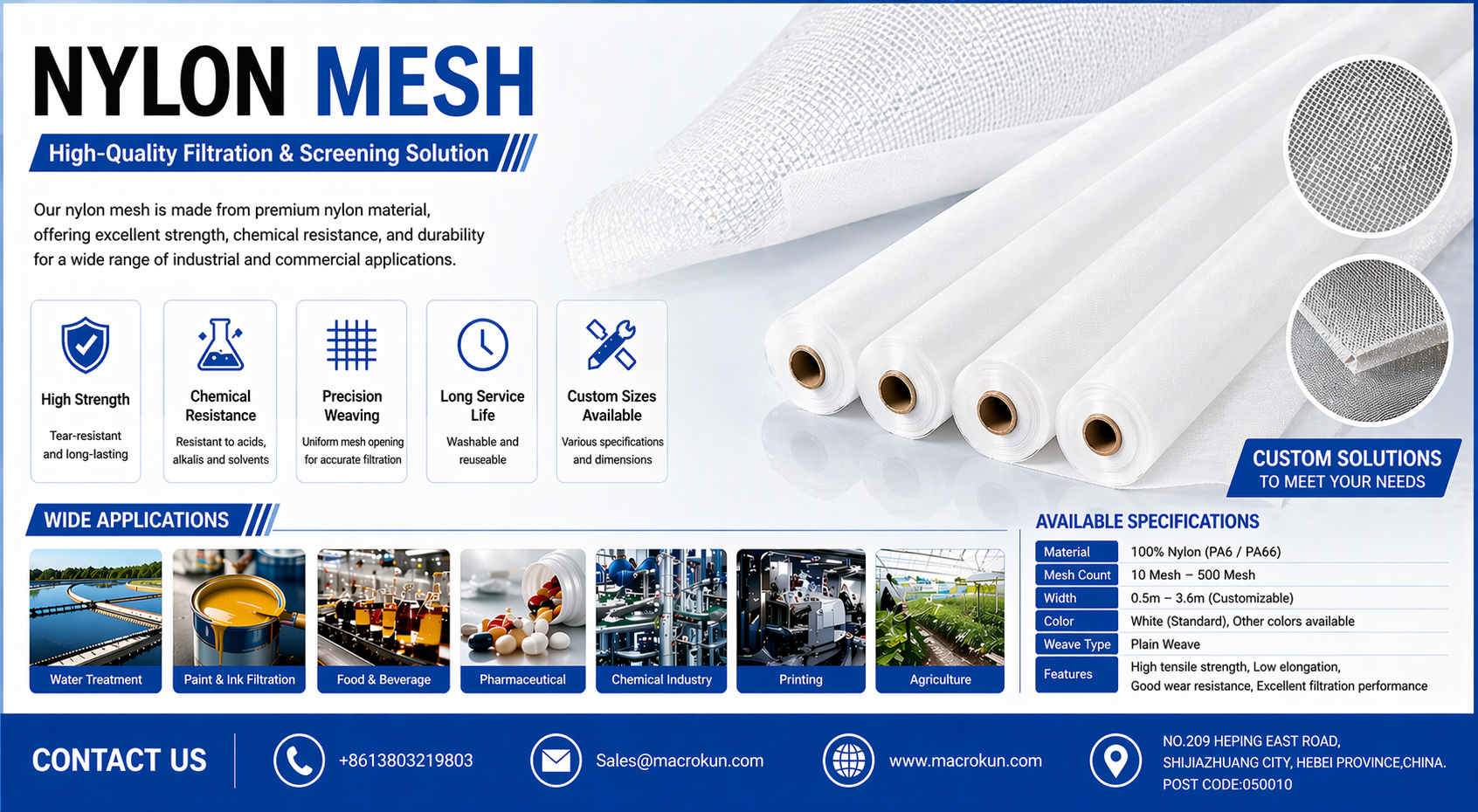
Nylon filter mesh is widely used in filtration systems where precision, flexibility, and repeatable performance are essential. One of the most important technical factors influencing how nylon filter mesh performs in real-world applications is the nylon mesh filter opening size. This parameter directly affects particle retention, flow behavior, and overall filtration efficiency, making it a key consideration for engineers, buyers, and system designers.
Rather than being a simple numeric specification, the opening size of nylon mesh reflects the balance between separation accuracy and throughput. Selecting the correct opening size is critical to ensuring that a filtration process operates reliably under its intended conditions.
What Nylon Mesh Filter Opening Size Represents
The nylon mesh filter opening size refers to the clear space between adjacent nylon filaments after weaving and heat setting. This opening determines the maximum particle size that can pass through the mesh. In practical terms, it defines the filtration threshold of the material.
.jpg)
Unlike solid membranes, nylon filter mesh relies on a uniform woven structure. The consistency of the opening size across the entire mesh surface ensures predictable filtration results. Even minor variations can influence performance, especially in applications where fine particles or narrow tolerance ranges are involved.
Relationship Between Opening Size and Mesh Count
Opening size is closely related to mesh count, which describes the number of threads per linear inch or centimeter. Higher mesh counts generally result in smaller openings, while lower mesh counts produce larger openings. However, these two parameters are not interchangeable.
For nylon filter mesh, the filament diameter also plays a significant role. Two meshes with the same mesh count can have different opening sizes if different thread diameters are used. This is why opening size is often the preferred specification when filtration accuracy is critical.
Understanding this relationship helps users avoid common selection errors, such as choosing a mesh based solely on mesh count without considering the actual opening size required by the process.
Influence on Filtration Accuracy and Flow Rate
The nylon mesh filter opening size directly impacts filtration accuracy. Smaller openings provide finer particle retention, which is essential in applications involving powders, pigments, or fine suspensions. At the same time, reduced opening size increases flow resistance, which may affect system pressure or throughput.
Larger opening sizes allow higher flow rates and reduced pressure drop, making them suitable for coarse filtration or pre-filtration stages. In many systems, nylon filter mesh is selected with an opening size that balances adequate particle removal while maintaining stable flow conditions.
This balance is especially important in continuous processing environments where filtration performance must remain consistent over extended operating periods.
Application-Specific Opening Size Selection
Different industries rely on different nylon mesh filter opening size ranges based on process requirements. In liquid filtration, opening size determines how effectively the mesh removes suspended solids without clogging too quickly. In dry material screening, opening size influences separation efficiency and material recovery.
For example, in water treatment or chemical processing, nylon filter mesh with controlled opening sizes is often used to protect downstream components. In food and beverage applications, opening size selection supports product clarity while maintaining process efficiency.
Choosing the correct opening size at the design stage helps prevent operational issues such as excessive fouling, frequent cleaning, or inconsistent filtration results.
Manufacturing Precision and Opening Size Consistency
Maintaining a stable nylon mesh filter opening size requires precise manufacturing control. Factors such as weaving tension, filament quality, and heat-setting conditions all influence the final opening size. A well-controlled production process ensures that the opening size remains uniform across the mesh surface and from batch to batch.
Consistency is particularly important for customers who rely on nylon filter mesh as a critical functional component rather than a consumable accessory. Stable opening size performance simplifies quality validation and reduces variability in finished products or filtration systems.
This level of precision allows nylon filter mesh to be integrated confidently into equipment that demands repeatable and predictable filtration behavior.
Opening Size and Cleaning Performance
The opening size of nylon filter mesh also affects how easily the mesh can be cleaned and reused. Meshes with very fine openings may trap particles more tightly, requiring more thorough cleaning procedures. Larger openings, on the other hand, release trapped particles more easily during backwashing or rinsing.
Selecting an appropriate opening size helps extend service life by reducing the risk of permanent clogging or mechanical stress during cleaning. In reusable filtration systems, this consideration can significantly influence maintenance frequency and operational cost.
By aligning opening size with both filtration and cleaning requirements, nylon filter mesh can deliver reliable long-term performance.
Tolerance Control and Custom Specifications
In many applications, standard opening sizes may not meet exact system requirements. Custom nylon filter mesh solutions allow opening size tolerances to be defined according to specific performance targets. This is particularly useful in OEM filtration systems or specialized industrial equipment.
Custom specifications ensure that the nylon mesh filter opening size aligns precisely with process parameters such as particle size distribution, flow velocity, and operating pressure. This approach reduces the need for system adjustments and improves overall filtration stability.
Precision tolerance control also supports scalability, allowing systems to perform consistently as production volumes increase.
Practical Value of Proper Opening Size Selection
Understanding and selecting the correct nylon mesh filter opening size is essential for achieving reliable filtration outcomes. It influences not only particle separation but also flow behavior, cleaning efficiency, and system longevity.
When nylon filter mesh is matched correctly to its application, it becomes a stable and predictable filtration medium rather than a variable factor. This reliability supports smoother operations, fewer interruptions, and better overall process control.
RELATED PRODUCTS
RELATED ARTICLES
Tags:
 WhatsApp